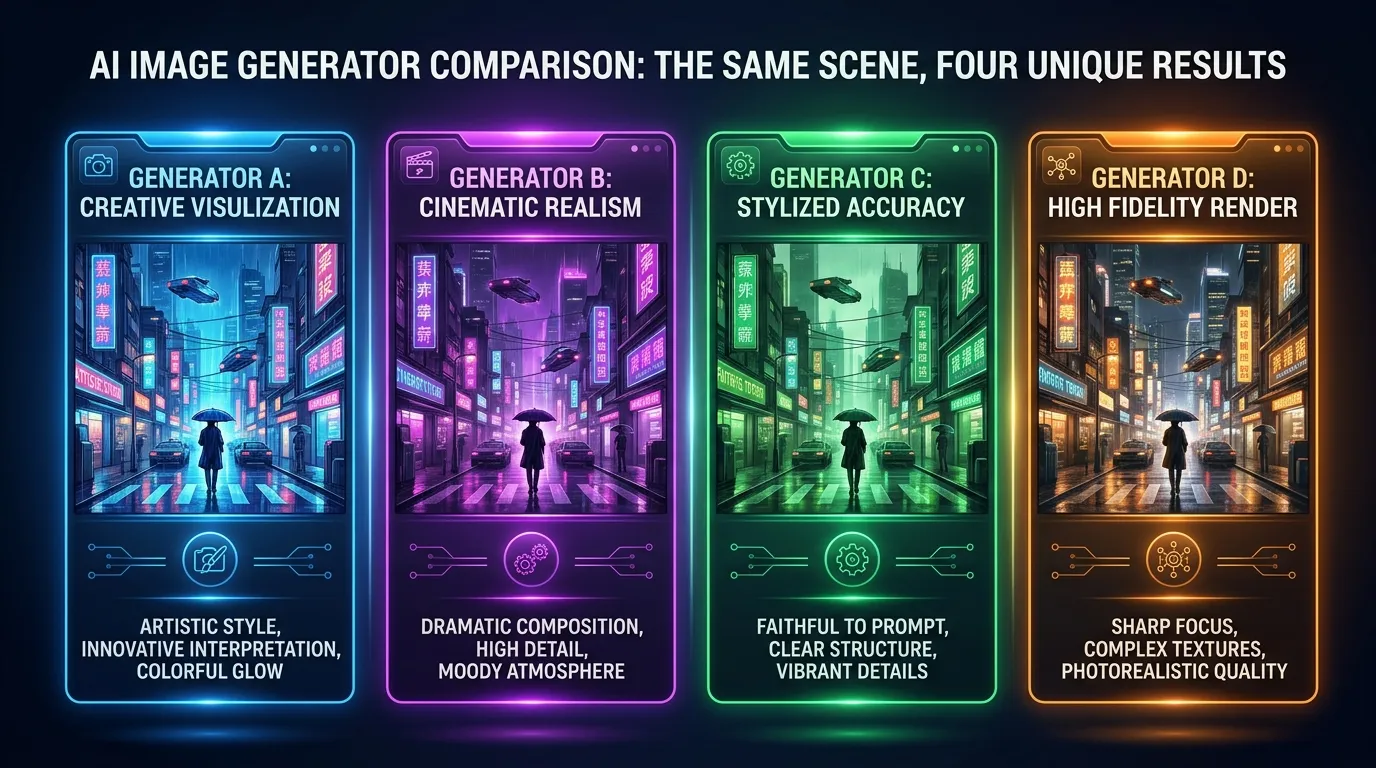
Choosing the right AI image generator can make the difference between a usable marketing asset and a discarded experiment. In 2026, three names dominate the conversation: GPT Image 2 from OpenAI, DALL-E 3 (OpenAI's previous generation), and Midjourney (the indie favorite). Each has distinct strengths, and the best choice depends on what you need to create.
This guide compares all three on output quality, text handling, ease of use, pricing, and real-world use cases.
Quick Comparison
| Feature | GPT Image 2 | DALL-E 3 | Midjourney V7 |
|---|---|---|---|
| Photorealism | Excellent | Good | Very Good |
| Text rendering | Excellent | Moderate | Poor |
| Instruction following | Excellent | Good | Moderate |
| Artistic styles | Very Good | Good | Excellent |
| Image-to-image | Yes | Limited | Yes |
| Speed | Moderate | Fast | Moderate |
| Ease of use | Very Easy | Easy | Moderate |
| Best for | Professional, commercial work | Quick, simple generation | Artistic exploration |
GPT Image 2: The New Standard
GPT Image 2 is OpenAI's latest image generation model. It builds on the multimodal foundation of GPT-4o and delivers measurable improvements in photorealism, text rendering accuracy, instruction following, and output consistency over DALL-E 3.
Strengths
Photorealism: GPT Image 2 produces images with convincing textures, accurate lighting, and natural color rendering. Skin tones look realistic, materials have proper sheen and depth, and environmental lighting behaves physically. For product photography and commercial visuals, these improvements mean fewer post-processing corrections and faster turnaround from prompt to final asset.
Text rendering: This is where GPT Image 2 pulls ahead of the pack. It can accurately render text inside images: signs, labels, posters, book covers, and UI elements, all with correct spelling, consistent fonts, and proper spatial placement. If your projects involve typography within images, GPT Image 2 is currently the strongest option available.
Instruction following: The model understands complex, multi-part prompts and executes them accurately. You can specify exact layouts, quantities, spatial relationships, and style combinations, and GPT Image 2 will respect those instructions. This predictability saves time and reduces the number of re-generations needed.
Natural language prompting: Because it's built on GPT's language model, GPT Image 2 understands conversational prompts. You don't need special syntax or keyword tricks; just describe what you want clearly.
Weaknesses
- Generation speed is moderate compared to faster models like FLUX.1 Schnell
- Artistic and stylized outputs are strong but Midjourney still has an edge in certain aesthetic domains
Best For
Marketing teams, e-commerce sellers, content creators, and anyone who needs photorealistic images with text elements and reliable instruction following.
DALL-E 3: OpenAI's Previous Generation
DALL-E 3 served as OpenAI's flagship image model before GPT Image 2 launched. It is still widely used and produces solid results, especially for simpler generation tasks. For users already working inside the ChatGPT ecosystem, it remains the most accessible entry point.
Speed: DALL-E 3 generates images quickly, making it suitable for high-volume workflows where turnaround time matters more than maximum quality.
Simplicity: The model works well with short, straightforward prompts. You don't need to write a paragraph to get a decent result.
Where It Falls Short
- Text rendering is inconsistent: letters are often misspelled or deformed
- Photorealism is good but noticeably below GPT Image 2
- Instruction following can be unreliable with complex, multi-element prompts
- Limited image-to-image editing capabilities
When to Reach for DALL-E 3
Quick generations where speed matters more than perfection, casual users who want simple results, and workflows already integrated with the ChatGPT ecosystem.
Midjourney: The Community-Driven Artist's Tool
Midjourney occupies a unique position in the AI image landscape. Unlike OpenAI's models, it was built from the ground up with a focus on aesthetics and creative exploration, guided by an active community on Discord that shares prompt libraries, style guides, and creative inspiration. Version 7 continues that tradition.
What Midjourney Does Well
Artistic quality: Midjourney's output has a recognizable aesthetic built on rich colors, dramatic compositions, and a painterly quality that many users find appealing. It excels at concept art, illustrations, and creative exploration.
Style consistency: Midjourney maintains a cohesive aesthetic across generations, which is valuable for projects requiring a consistent visual identity.
Limitations to Know About
- Text rendering is poor: text in images is usually garbled or misspelled
- Instruction following can be unpredictable with specific, detailed requirements
- The Discord-based interface can be clunky for professional workflows
- Prompt engineering requires more skill and experimentation
- No free tier; requires a paid subscription
Who Should Use Midjourney
Artists, illustrators, and creative professionals who prioritize aesthetic quality over precise instruction following or text rendering.
Head-to-Head Comparisons
Photorealism
Winner: GPT Image 2
GPT Image 2 produces the most convincing photorealistic images of the three. Material textures, lighting behavior, and environmental details are rendered with accuracy that rivals professional photography. Imagen 3 is also excellent in this category, though it approaches photorealism through a different technical approach.
Midjourney V7 is close behind in overall image quality, but its outputs tend to have a slightly stylized quality even when prompted for photorealism. DALL-E 3 produces good results but struggles with fine details and complex lighting scenarios.
Text Rendering
Winner: GPT Image 2
This is the most decisive category. GPT Image 2 renders text with accuracy that earlier models could not reliably achieve. DALL-E 3 can handle simple words but struggles with longer text. Midjourney essentially cannot render readable text. It produces letters that look like text but are usually illegible.
If your work involves text in images (posters, product packaging, social media graphics, UI mockups), GPT Image 2 is the clear choice. Ideogram V3 is another strong option specifically optimized for text rendering.
Instruction Following
Winner: GPT Image 2
When you need precise control over what appears in the image, GPT Image 2 delivers. It handles specific spatial arrangements, exact quantities, and complex compositional instructions reliably. This is particularly valuable for commercial work where the output needs to match a specific brief.
DALL-E 3 follows instructions reasonably well for simple prompts but becomes less reliable as complexity increases. Midjourney tends to interpret prompts creatively, which is great for artistic exploration but frustrating when you need specific, predictable results.
Artistic Styles
Winner: Midjourney
Midjourney's aesthetic sensibility gives it an edge for artistic and illustrative work. Its outputs have a distinctive quality that many users find more visually appealing for creative projects. GPT Image 2 can produce artistic styles when prompted but tends toward realism by default. DALL-E 3 is competent across styles but rarely exceptional in any single one.
For professional design work that requires both quality and control, FLUX.2 Pro is also worth considering. It offers detailed compositional control with high output quality.
Pricing Comparison
| Platform | Model | Pricing Model | Free Tier |
|---|---|---|---|
| Kairval | GPT Image 2 | Credit-based | Free credits for new users |
| Kairval | DALL-E 3 (GPT-4o Image) | Credit-based | Free credits for new users |
| Midjourney | V7 | Monthly subscription ($10-$60/mo) | No |
On Kairval, both GPT Image 2 and DALL-E 3 are available through a unified credit system, meaning you can try both without managing separate subscriptions. This makes it easy to A/B test which model works best for your specific use cases. Check the pricing page for current credit packages.
Which Should You Choose?
Choose GPT Image 2 if you need:
- Photorealistic commercial imagery
- Accurate text rendering inside images
- Precise instruction following for brand-consistent output
- Both text-to-image and image-to-image capabilities
- A single model that handles most professional use cases
Choose DALL-E 3 if you need:
- Fast, simple image generation
- Lower cost per generation
- Quick visual ideas and rough concepts
Choose Midjourney if you need:
- Distinctive artistic aesthetics
- Concept art and creative exploration
- A community-driven creative environment
Practical Next Steps
The comparison above should give you a clear picture of where each model excels. If you want to see the differences with your own eyes, the fastest way is to run the same prompt through all three and compare the results side by side.
To test GPT Image 2 and DALL-E 3 now: Open the text-to-image tool, write a prompt that includes text elements (for example, "a coffee bag label reading 'Single Origin Ethiopia' with a watercolor illustration of coffee cherries"), and generate with each model. The text rendering gap will be immediately visible.
To dig deeper into GPT Image 2: The What Is GPT Image 2 guide covers its architecture and capabilities in detail, and the best prompts article provides ready-to-use templates.
To explore the full model lineup: The model catalog includes Imagen 3, FLUX.2 Pro, Ideogram V3, and others worth testing for specific use cases like text-heavy designs or high-speed batch generation.
The Bottom Line
In 2026, GPT Image 2 is the most versatile AI image generator for professional use. It leads in the areas that matter most for commercial work: photorealism, text rendering, and instruction following. Midjourney remains the best choice for artistic exploration, while DALL-E 3 serves as a reliable option for quick, simple generations.
The practical advantage of a multi-model platform like Kairval is that you can match each project to the model that fits it best rather than committing to a single tool.

![Gemini vs ChatGPT: Which AI Is Better? [2026]](/kairval/images/blog/00ede4e2-92de-421e-b378-ac6d2ba8fa05.webp "Gemini vs ChatGPT: Which AI Is Better? [2026]")